
Looking Slowly at an Ordinary Place
In Frequent Whites, Maho turns her attention to Pardis, a new city on the outskirts of Tehran, characterised by the repetition of large-scale housing developments and the distant presence of Mount Damavand. What begins as an encounter with a changing urban landscape gradually develops into a reflection on architecture, migration, memory and belonging.
In this interview, we talk with Maho about the making of the project and about a photographic practice grounded in sustained and attentive observation. From the relationship between document and interpretation to the role of light, the seasons, landscape and photographic sequence, the conversation explores how photographing an apparently ordinary place can reveal the lives, tensions and transformations held within architecture — even when people remain outside the frame.
Born in 1985 in Isfahan, Iran, Maho is an independent photographer based in Tehran. He holds an art degree from the Ministry of Culture and Arts of Iran, equivalent to a master’s in photography, as well as a BA in Photography from Isfahan University and a diploma from Isfahan Fine Arts Academy. His work combines documentary and artistic approaches, with a focus on portraiture, street photography, and landscape. Alongside his photographic practice, Maho has worked as a photojournalist since 2007 and has held positions as director of photo departments and as a juror in national photography festivals. He has published two personal photography books and led numerous workshops and exhibitions. His awards include first place in the Portrait category at the 82nd POY (2025), the Street Photographers Foundation Black and White Photography Competition (2024), and the Landscape category of the Sony World Photography Awards (2021), among over 300 national and international distinctions. His work has been shown in ten solo exhibitions in Iran, Germany, and India, and in over 150 group shows worldwide. He is a member of the Iran Press Photographers Association, the Iranian Cultural Heritage Photographers Association, and the Iranian Photographers Association.
You began with painting at the Fine Arts Academy in Isfahan, alongside experimental photography. What did painting give you that remained important when photography became your principal medium?
More than anything, painting taught me to look more slowly. It made me sensitive to composition, colour, light and the relationships between different elements within a frame. But, perhaps more importantly, it taught me patience and attentiveness. I learnt that sometimes, in order really to see something, you need to spend a long time looking at it. That way of looking is still a very important part of my photography.
When did photography begin to feel like a personal language rather than simply another artistic technique?
There wasn’t one particular moment; it happened gradually. Little by little, I realised that photography allowed me both to engage with reality and to express my own interpretation of it. I could observe the world while also thinking about it and reconstructing it through my own point of view. That was when photography began to shift from being an artistic technique towards something closer to a personal language.
You spent many years working in photojournalism while developing independent projects. How have those two approaches shaped one another?
Photojournalism taught me speed, precision and attentiveness to reality. In news photography you have to see very quickly, make decisions quickly and allow events themselves to reveal something to you. Personal projects are different. They give me the possibility of slowing down, staying longer and thinking about things that may not have simple answers. I think these two approaches have complemented one another throughout my work.
Did journalism also shape the way you think about neutrality and interpretation?
Yes, absolutely. Journalism taught me to look at reality before interpreting it and to respect what is actually there. But later I also came to understand that photography can never be completely neutral. From the moment I decide where to stand, what to include within the frame and when to press the shutter, I am already interpreting. In my personal work, this subjective dimension has become increasingly important.
Frequent Whites refers to a very real social and urban condition, yet it does not function like a conventional report on housing. Do you think photography becomes particularly powerful when document and interpretation coexist?
Yes. I don’t see documentary and artistic photography as two completely separate things. A photograph can begin with a very specific reality while at the same time conveying the photographer’s own feeling and interpretation of it. For me, it is important that a photograph says something real about a place, but also leaves enough space for the viewer to think, imagine and interpret for themselves.
©Maho
How did Pardis first emerge as a photographic subject for you?
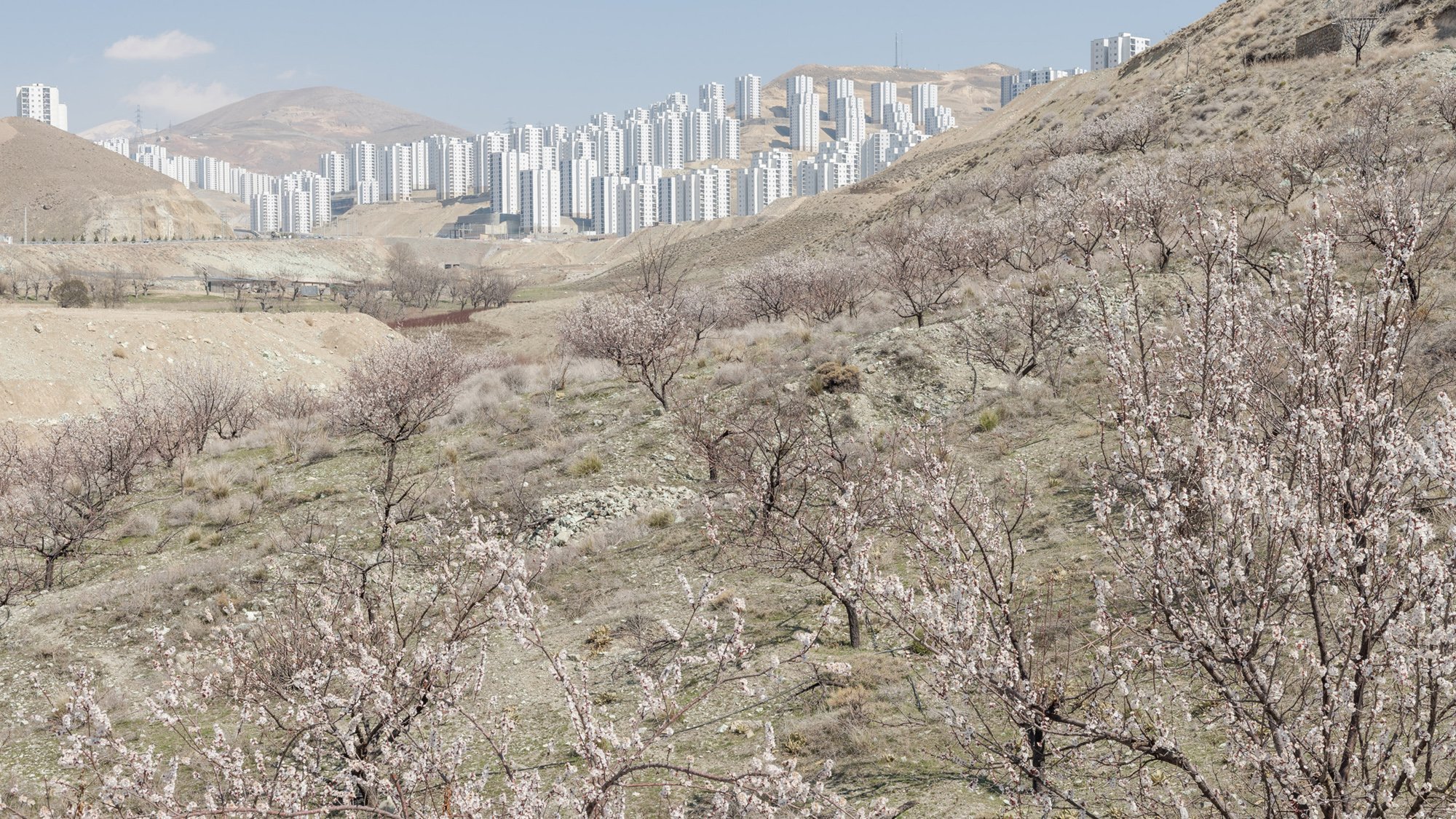
I was already familiar with the landscape around Tehran and with the way the city has been expanding towards the Alborz Mountains. What immediately caught my attention in Pardis was the contrast between the enormous volume of construction and the natural landscape surrounding it. The buildings were highly repetitive and almost anonymous, while the mountains introduced a completely different sense of scale and time. That contrast fascinated me.
What made you keep returning, and when did you realise Pardis had become a project rather than simply a place you were photographing?
At first, I was simply photographing a place that I found visually interesting. But after returning several times, I began to realise that the same buildings could look completely different depending on the season, the light, the weather and even my own state of mind. That was when I understood that Pardis was no longer simply a subject. It had become a project. If I really wanted to understand the place, I needed to spend more time with it.
How did you arrive at the title Frequent Whites?
The word ‘white’ came directly from the architecture. White is present almost everywhere in these buildings. ‘Frequent’, or the idea of recurrence, refers to the repetition of the buildings, windows and balconies, but also to the repetition involved in my own act of returning to the same place again and again. And yet, every time I return, I see something different. So the title is simultaneously about repetition and difference.
Was discovering difference within repetition one of the central concerns of the project?
Exactly. At first glance, the buildings appear almost identical. But when you spend more time looking, differences begin to emerge. Light, weather, vegetation, distance and the presence of the mountains all transform what you see. I became very interested in that contradiction: how something can appear extremely repetitive and yet reveal a different face every time you encounter it.
These are not celebrated works of architecture, yet you treat them with considerable visual attention. What attracts you to buildings and places that might otherwise be overlooked?
I’m often more interested in ordinary places than in celebrated architecture. Famous buildings have already been photographed, seen and discussed many times. Ordinary buildings, on the other hand, are part of people’s everyday lives, and they can tell us a great deal about society, economics, migration and ways of living. I think photography can give these overlooked places the possibility of being seen again.
Did photographing Pardis gradually become an act of saying that this place deserves to be looked at carefully?
Yes, although I wouldn’t say it began as a political or theoretical decision. That awareness developed gradually through spending time with the place. When a photographer looks closely and persistently at an ordinary place, that act of looking begins to acquire meaning in itself. I wanted to see something that many people might simply pass by without noticing.
What does Pardis represent to you within the wider transformation of Tehran?
For me, Pardis is one of the consequences of the pressures created by a large city and its constant expansion. Tehran’s population and many of its problems have gradually been pushed outwards, producing new cities around it. Geographically, Pardis lies outside Tehran, but psychologically it remains very dependent upon Tehran. It occupies a space somewhere between belonging and displacement — between the hope of beginning a new life and leaving behind something that previously existed.
©Maho
Rather than addressing migration directly through portraits or individual stories, you allow architecture and landscape to suggest those experiences. Why did you choose this indirect approach?
Because I didn’t want to reduce migration to a few individual stories or faces. Migration is not only the movement of people; it also transforms landscapes and ways of living. Architecture can reveal the consequences of this displacement without necessarily showing people directly. I think this indirect approach also gives the viewer more space to imagine the lives taking place behind these buildings.
Can architecture become an archive of migration, aspiration, necessity and displacement?
Yes, definitely. Buildings are the result of the decisions and circumstances that brought them into existence. They tell us something about why and how people came to live in a particular place, and about the kind of future that was imagined for them. Architecture doesn’t tell these stories directly, but it retains their traces. In that sense, I see these buildings as a kind of silent social archive.
Frequent Whites is deeply concerned with human experience, yet people are rarely foregrounded. Was that relative absence deliberate?
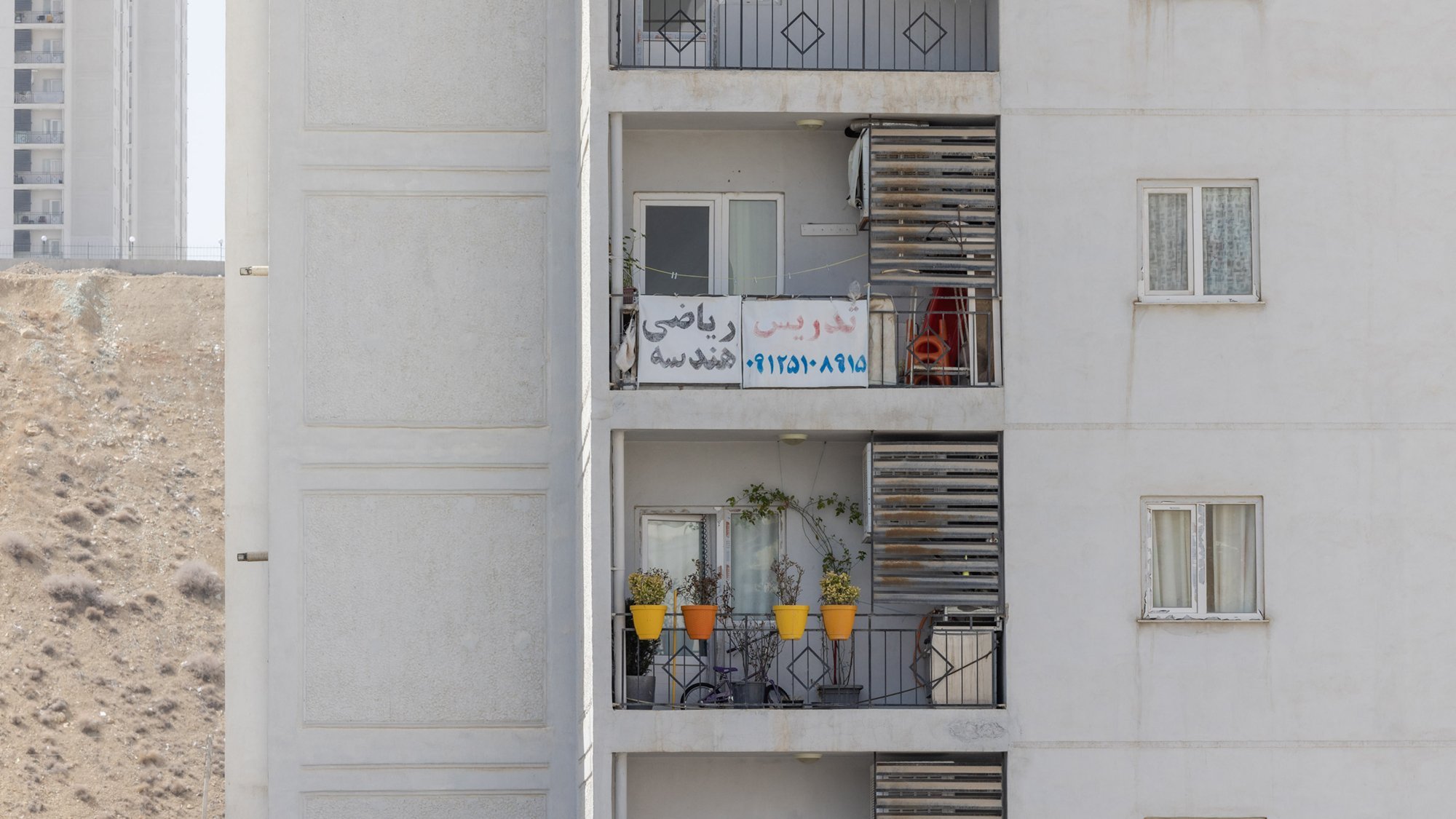
Yes, to a large extent it was deliberate. I didn’t want one particular person to become representative of the entire experience of living in Pardis. Instead, I preferred to suggest human presence through the architecture and through signs of everyday life: windows, balconies, playgrounds, green spaces and all those small elements that tell us life is continuing behind these buildings.
©Maho
Does the absence of people give viewers more room to imagine the lives taking place behind the façades?
Yes, and that is important to me. When you photograph a person directly, the viewer may associate the story mainly with that particular individual. When people are absent, however, the viewer has to imagine them. The building can then become a space containing many possible stories rather than a single one.
Could Frequent Whites be understood as a kind of portrait without portraits?
Yes, I completely agree with that interpretation. For me, the project is a kind of collective portrait. People may not be physically present in many of the photographs, but their lives can be felt through the spaces they have built, inhabited and occupied. In a sense, rather than photographing people’s faces, I have photographed the conditions in which their lives take place.
Mount Damavand appears almost like another character in the project. What does it represent to you, culturally and personally?
For Iranians, Damavand is much more than a mountain. It is an important part of Iranian mythology, literature, history and collective memory. For me, its presence in this project is connected above all with the idea of continuity. The buildings in Pardis are new and changeable, while Damavand is incomparably older. That difference in time is very important to me.
Were you consciously bringing those two temporalities — rapid urban construction and the mountain’s geological and cultural duration — into the same frame?
Yes. That contrast became one of the central ideas of the project. In the foreground, we have buildings constructed very rapidly in response to the needs of an expanding city. Behind them is a mountain with an immensely long geological, cultural and mythological history. Bringing these two elements together creates, for me, a dialogue between past and present.
Does Damavand also give Pardis an identity that its repetitive architecture might otherwise erase?
Absolutely. The buildings are extremely repetitive, and without the mountain they could perhaps be imagined as belonging to many other cities. Damavand makes this place specific and unique. The mountain gives this otherwise anonymous architecture a geographical and cultural identity.
When did seasonal change become part of the structure of the project?
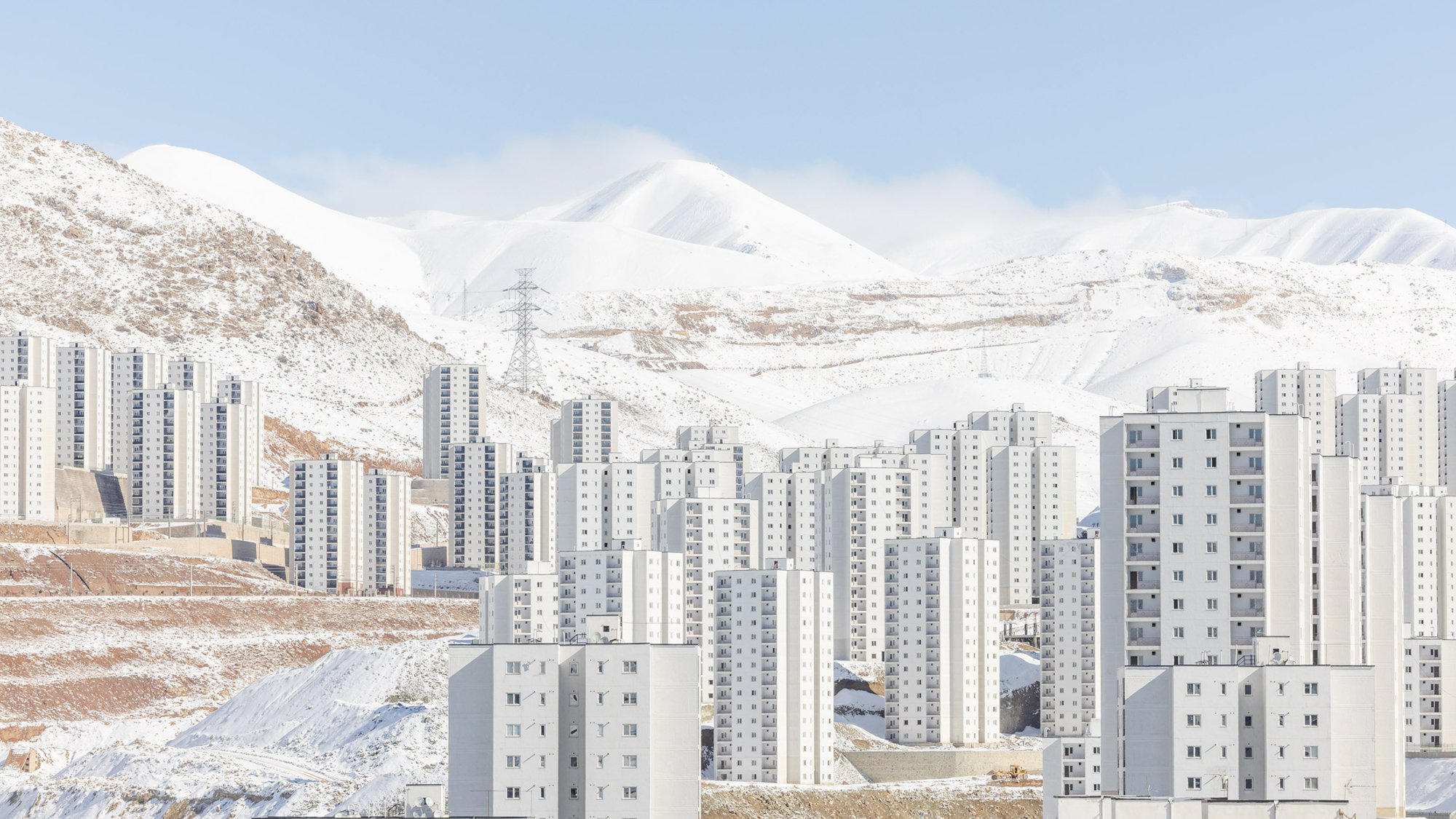
Quite early on, I realised that if I photographed these buildings during only one season, I would lose an important part of the story. The buildings themselves remain relatively stable, while almost everything around them changes. I became interested in that relationship between permanence and transformation, and working through all four seasons allowed me to introduce the passage of time into the photographs.
Was it important to return to similar places and discover how different conditions could change the emotional experience of the same architecture?
Very much so. The same building can appear warm and alive in summer, cold and isolated in winter, mysterious in fog and somehow renewed again in spring. The building itself has hardly changed, but our emotional response to it has. That difference became one of the main tools of the project.
How much do you plan for particular weather and lighting conditions, and how much do you leave to chance?
I pay close attention to weather and light, but I don’t try to control everything completely. Usually, I go to a place with some initial idea of what I am looking for, but I also allow the place itself to suggest something to me. Sometimes I go looking for one particular image and return with something completely different. For me, one of the most interesting things about photography happens precisely where planning and chance meet.
Light seems to alter the emotional character of the buildings in Frequent Whites. How consciously do you use it to construct atmosphere?
Very consciously, although I try not to make it theatrical. For me, light is not simply a means of illuminating a building. It can completely change the way we feel about that building. Soft light can make a building seem calm or fragile, while hard light can make exactly the same building feel cold, distant or even heavy. So light becomes part of the meaning of the photograph.
Can photography make the same building psychologically different simply through time, weather and light?
Yes, absolutely. Physically, it is still the same building, but our experience of it changes. For me, this is one of the most fascinating aspects of photographing architecture. I am not only photographing the building itself; I am also photographing its relationship with time, nature and human emotion.
The photographs are visually compelling, yet the social realities behind them involve necessity, displacement, anonymity and peripheral urbanisation. Were you concerned that beauty might aestheticise the conditions you wanted to question?
Yes, that is something I think about. Beauty can become dangerous if it makes us forget what exists behind the image. But I don’t believe that beauty and critical thinking are necessarily opposed to one another. I use beauty as a way of drawing the viewer into the image. My hope is that, once they have entered it, they will gradually begin to notice the tension, repetition, isolation and social questions that exist behind that beauty.
How do you find an ethical balance between creating a powerful image and remaining faithful to reality?
For me, the most important principle is to remain honest with reality. I can choose where to place the camera, when to photograph and how to compose the image, but I should not transform reality into something it is not. I try to preserve the complexity of the subject and not explain everything to the viewer. Part of the meaning should remain in their hands.
Frequent Whites works as a sequence rather than through a single defining image. How do you edit your work, and when do individual photographs begin to form a narrative?
For me, editing is almost another stage of photography. I don’t only ask whether an individual photograph works on its own; I also ask what happens when it is placed beside the next photograph. When repetition, contrast, rhythm and silence begin to create relationships between the images, I feel that the project is starting to take shape. The narrative usually emerges from the accumulation of those relationships.
Has your experience of directing and screenwriting influenced the way you think about photographic sequences?
Yes, definitely. Cinema helped me to think about rhythm, distance, transition and the relationship between one frame and the next. In a photographic sequence, you may need a wide image to establish the space, then a closer image, and perhaps afterwards a quieter photograph that gives the viewer a moment to breathe. For me, editing a photographic series is, to some extent, like editing a film without movement.
Do you value photographs that may be quiet or secondary on their own, but become essential within the sequence?
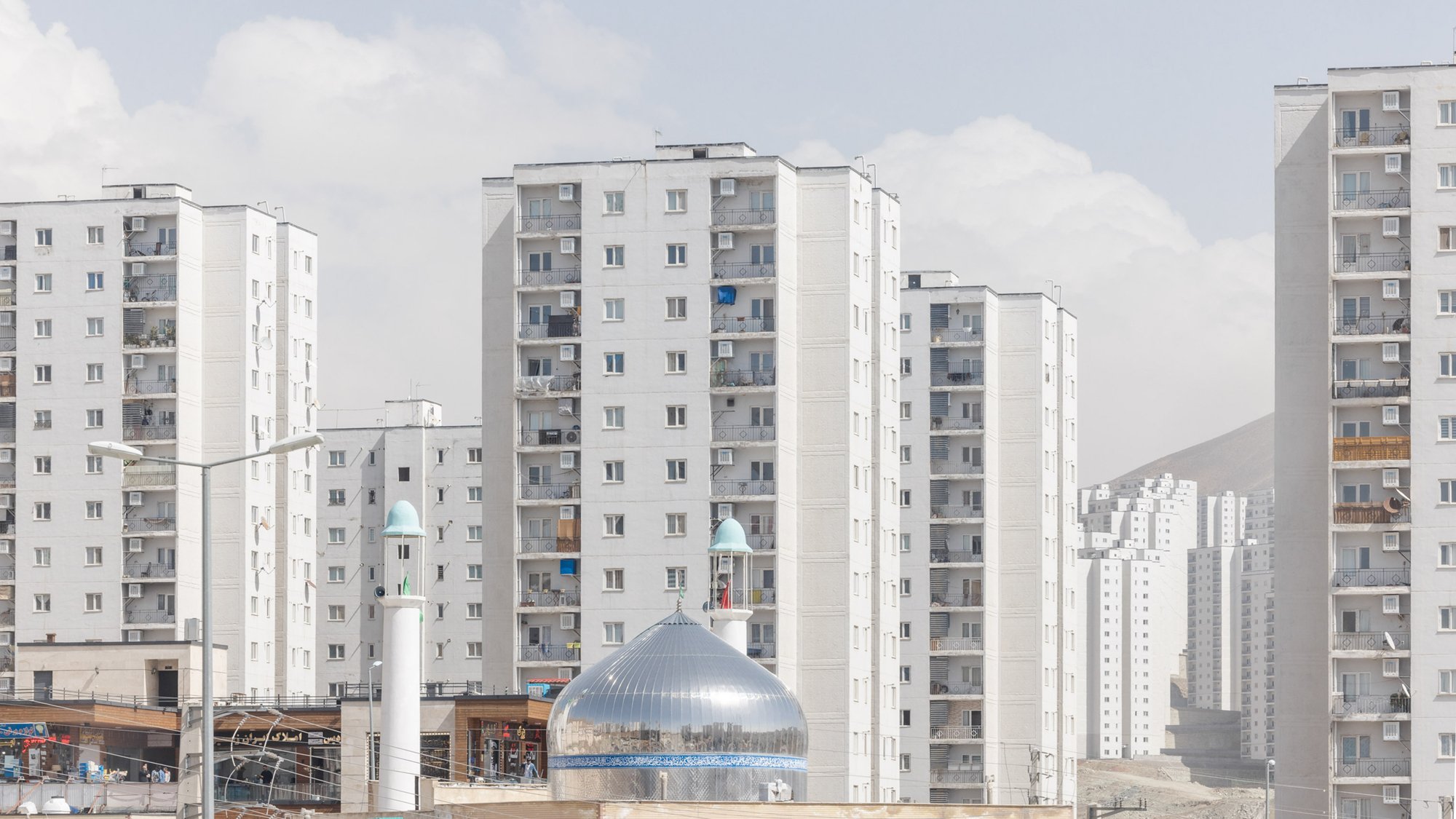
Very much. Some photographs may not be the strongest images in the series when viewed individually, but they are essential within the sequence. They create silence, distance or breathing space. I don’t think every photograph in a project has to shout. Sometimes a quiet image allows the entire series to be heard more clearly. One example for me is the solitary curve of the metal dome in Pardis — a kind of quiet defiance within a grid dominated by straight lines.
How do you recognise the point at which you are no longer simply collecting photographs, but have discovered the internal logic of a project?
When I stop looking only for good individual photographs and begin to understand the relationships between them, I feel the project has entered a different stage. Gradually, repetition, the seasons, light, landscape and Damavand began to form a shared visual language. That was when I understood that I was no longer simply photographing Pardis. I was thinking through an idea.
And how do you recognise when a project should end? Is Frequent Whites finished for you?
I think the first chapter of the project is complete, but Pardis is not entirely finished for me. I may return in the future, but I wouldn’t want to go back simply to repeat the photographs I have already made. If I discover a new question, then I will return. For me, a project reaches its end when I feel I have followed its central question far enough.
Frequent Whites is deeply rooted in Iran, while addressing questions — housing, displacement, urban expansion and belonging — that resonate far beyond it. How important is that balance between specificity and wider relevance?
It is very important. I think a photograph can become universal precisely because it is deeply rooted in a very specific place. Pardis is unmistakably an Iranian place, but questions of migration, housing, displacement, urban expansion and belonging exist in many parts of the world. I would like the viewer to enter the project through Iran, but then to recognise something within it that extends beyond Iran.
As an independent photographer working in Tehran, what are the possibilities and difficulties of sustaining long-term projects?
The greatest difficulty is maintaining continuity. A long-term project requires a great deal of time, money, travel and energy, and for an independent photographer this is not always easy. But independence also gives me an important advantage: I can follow a project for years without having to adapt it to a commission or to the requirements of a particular publication or media organisation. That freedom is extremely valuable to me.
Do you feel a responsibility to offer international audiences a more complex image of Iran?
Yes, although I don’t think my responsibility is to create either a positive or a negative image of Iran. My responsibility is to show complexity. Iran is not one image and it is not one story. Through photography, I try to reveal layers of Iranian life and society that may be less visible within the more familiar or stereotypical images of the country.
Can an award genuinely change the life of a project?
Yes. An award can give a project a new life. It can bring the work to audiences, curators and institutions that might otherwise never have encountered it. For an independent photographer, that visibility can be extremely important. But an award can also give the photographer confidence — a sense that the path they have chosen to follow is worth continuing.
What did receiving First Prize in the Luis Ferreira Alves International Photography Competition for Frequent Whites mean to you personally?
It meant a great deal to me because this project developed slowly, over a long period of time, and the subject is very personal to me. The fact that an international jury paid attention to the project and selected it within the context of contemporary architectural photography was an important form of recognition. Above all, it showed me that an apparently ordinary place such as Pardis could become part of an international conversation about architecture, landscape and human experience.
When you entered the Award, how did you understand the idea of ‘A Contemporary Look at Architecture’? Has winning changed your sense of where the project sits within architectural photography?
I understood the title as an invitation to look beyond the building itself. For me, architecture is not simply an object. It is connected to people, nature, memory and society. Winning the award reinforced this understanding. It confirmed for me that I don’t always have to photograph architecture simply as architecture. I can use architecture as a way of speaking about larger human questions.
Competitions can offer visibility, but they can also tempt photographers to anticipate what juries may reward. How have you protected your own voice?
I try not to photograph for competitions. I begin by photographing because I have a question or a concern that I want to explore, and I allow the project to develop from there. Only afterwards do I think about which exhibition or competition might be appropriate for the work. If, from the beginning, I try to guess what a jury might like, there is a real danger that I will gradually lose my own voice.
Do the strongest projects emerge when the photographer asks not ‘Will people like this?’ but ‘What do I genuinely need to understand or say?’
Exactly. For me, the second question is much more important. When you genuinely want to understand something, the work becomes both personal and honest. I cannot control whether everyone will like a photograph, but I can make sure that I believe in the question behind it. For me, serious photography begins there.
After returning to Pardis through different seasons and conditions, has the project changed the way you experience the landscape when you are there without a camera?
Yes, very much. Once you have photographed a place through different seasons and conditions, you can no longer see it simply as a collection of buildings. Now, even when I don’t have a camera with me, I notice changes in the light, the weather, vegetation and the signs of everyday life. I think one of the most valuable things photography can give us is precisely this transformation in the way we see.
©Maho
After more than two decades of photography, what still makes you stop and feel that something might become a photograph?
Usually some kind of contradiction — something I cannot immediately explain. It might be a relationship between nature and construction, or between beauty and discomfort, silence and human presence. Or it might simply be something completely familiar that suddenly appears strange. When I feel that kind of tension, I usually think there may be a photograph there.
What interests you now? Do you think the questions explored in Frequent Whites will continue into your future work?
I think some of these questions will remain present in my work, but I don’t want to repeat myself. I am still interested in the relationship between people and the spaces they create, and in the ways that memory, nature and social change become connected to particular places. But I would like to continue exploring these questions through different subjects and different visual approaches.
What advice would you give a young photographer embarking on a personal project that might take months or years to develop?
I would say: be patient, and remain faithful to your own question. Don’t worry too much about how impressive or complete the project appears at the beginning. Spend time with your subject. Return to it. Make mistakes. Put photographs aside and look at them again later. Allow the project itself to change over time. And, most importantly, don’t photograph what you think other people want to see. Photograph what you genuinely want to understand. If you stay with it for long enough, your own voice will gradually reveal itself.